
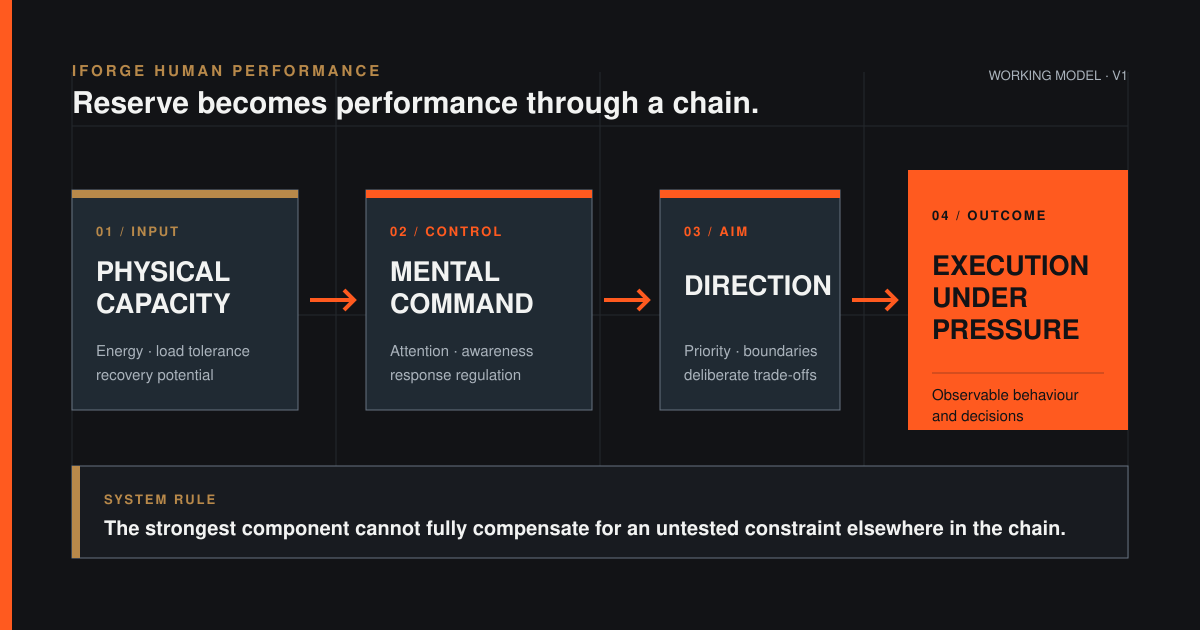
For an elite racing driver, neck strength, conditioning and reaction training are essential parts of preparation. They increase physical reserve. But physical reserve alone does not guarantee sound decisions under pressure. Recovery, attention, mental command and direction also shape what happens at the decisive moment.
Physical capacity is an important performance condition
Research shows that a short bout of exercise can improve cognitive function on average. A meta-review of thirty systematic reviews reported a small-to-medium effect. An earlier meta-analysis found a smaller positive effect and showed that duration, intensity, task and participant fitness can influence the outcome.
Physical training is therefore a relevant building block, but the studies do not show that more training always leads to better decisions. Nor is it clear that an effect observed in a laboratory task transfers directly to a decision involving time pressure, real stakes and fatigue.
Performance under pressure depends on several links
People respond differently to stress, and tasks make different demands. A review of decision making under stress describes behavioural and neural effects. Whether stress helps or impairs a decision depends partly on the situation and other moderating factors.
Short-term sleep deprivation affects attention, working memory and processing speed, among other domains, but not each domain equally. A strong body can therefore provide reserve while recovery, focus or direction still constrains execution.
“Am I fit?” is therefore too narrow a question. The more relevant issue is which part of the system constrains execution as pressure rises.
From fitness to a complete performance system
- Physical capacitysupplies energy, load tolerance and recovery potential.
- Mental commandhelps regain attention, detect pressure early and regulate impulses.
- Directiondecides what takes priority and which trade-off is made deliberately.
- Executionshows whether the first three links still hold under real load.
Identify what constrains execution
Before an upcoming peak, map the three domains and define the observable behaviour that must hold under load. Use the subsequent execution to decide where the first intervention is needed; additional training volume is only one possibility.
This approach treats physical training as an important condition without making it the complete explanation. It reflects more accurately how performance under pressure develops.